Title:
Take home message:
(1)For instance, A. protophormiae (SA3) and D. natronolimnaea (STR1) can promote wheat salt tolerance by altering endogenous phytohormone levels and TaCTR1/TaDREB2 expression 例如,A. protophormiae和D. natronolimnaea (STR1)可以通过改变内源植物激素水平和TaCTR1/TaDREB2表达来促进小麦的耐盐性【TaCTR1可能参与植物耐盐信号传导途径的负调控,而TaDREB2则作为转录因子参与小麦对干旱胁迫的响应】
(2)Furthermore, a positive regulation of PIP3-type aquaporins was found after exposure to B. megaterium B26 in maize under saline conditions, and A. brasilense AZ39 inoculation can also improve the transcription of a PIP-type aquaporinin barley, which might lead to enhanced water uptake in plants 此外,在盐条件下暴露于玉米中的巨大芽孢杆菌B26后,发现PIP3型水通道蛋白的正调节,并且接种巴西芽孢杆菌AZ39也可以提高大麦中PIP型水通道蛋白的转录,这可能导致植物中水分吸收的增加
(3)By inoculating maize with K. rhizophila Y1, the expression of ion transporters including ZmNHX3, ZmNHX2, ZmNHX1, and ZmHKT1 was significantly upregulated, providing protection from salt stress 通过用嗜根霉菌Y1接种玉米,包括ZmNHX3、ZmNHX2、ZmNHX1和ZmHKT1在内的离子转运蛋白的表达显著上调,提供了对盐胁迫的保护
(4)The inoculation of wheat plants with bacterial strains B. megaterium MPP7, B. tequilensis MPP8, and P. putida MPP18 causes a higher expression of genes such as SOS1 and SOS4 (encodes a pyridoxal kinase, loss of which leads to salt sensitivity in Arabidopsis), with an increase in relative water content (RWC) and photosynthetic pigmentation in plants 用细菌菌株巨大芽孢杆菌MPP7、龙舌兰芽孢杆菌MPP8和恶臭假单胞菌MPP18接种小麦植物导致基因如SOS1和SOS4(编码吡哆醛激酶,其丢失导致拟南芥盐敏感性)的更高表达,植物中相对水含量(RWC)和光合色素沉着增加
(5)Studies have shown that PGPB inoculation increases the production of certain osmolytes or osmoprotectants including Pro, betaine, trehalose, glycine, phenols, and flavonoids, leading to enhanced osmotic resistance in host plants 研究表明,PGPB接种增加了某些渗透调节物质或渗透保护剂的产生,包括脯氨酸、甜菜碱、海藻糖、甘氨酸、酚类和类黄酮,导致宿主植物的渗透抗性增强
(6)The osmotic resistance improvement might result from bacterial solutes being absorbed by roots directly, or PGPB-induced de novo synthesis of osmoprotectants in plants 渗透抗性的提高可能是由于细菌溶质被根直接吸收,或PGPB诱导植物渗透保护剂的从头合成.
Main:
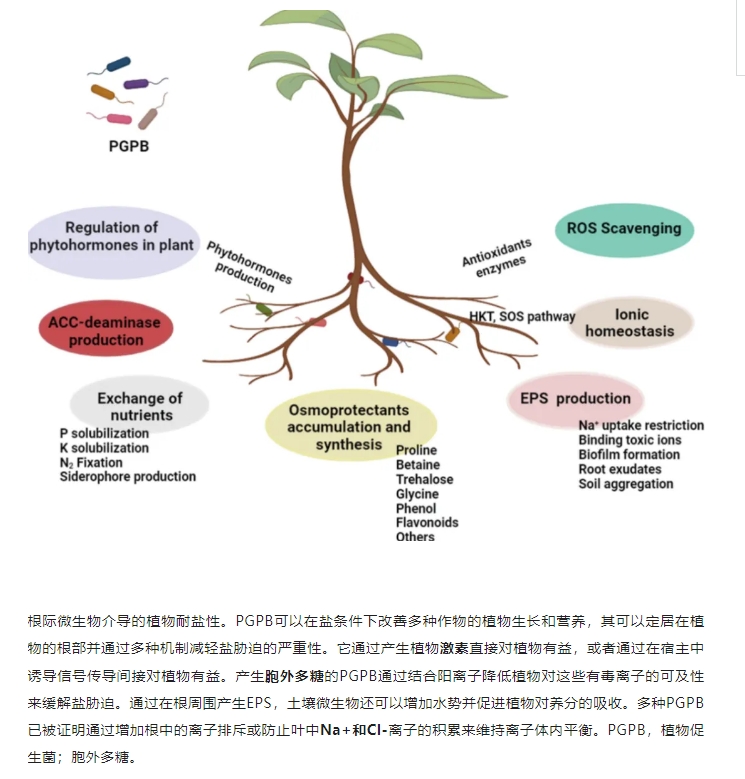
Rhizosphere microbiome-mediated plant salt tolerance
(1)Over the past decades, plant growth-promoting bacteria (PGPB) have been broadly used for sustainable agriculture in order to reduce chemical pesticides and fertilizers 在过去的几十年里,植物生长促进细菌(PGPB)已被广泛用于可持续农业,以减少化学农药和化肥
(2)Numerous studies have revealed that PGPB can improve both plant growth and nutrition of a variety of crops even under salt conditions 大量研究表明,即使在盐的条件下,PGPB也能改善植物生长和多种作物的营养
(3)PGPB benefits plants directly by producing phytohormones or indirectly by inducing signaling in the host PGPB通过产生植物激素直接或通过在宿主中诱导信号传导间接使植物受益
(4)Importantly, PGPB can colonize the roots of plants and alleviate the severity of salt stress through multiple mechanisms 重要的是,PGPB可以在植物根部定殖,并通过多种机制缓解盐胁迫的严重程度
(5)Under salt stress conditions, PGPB produced a variety of phytohormones that are capable of enhancing the leaf area, root growth, and the number of root tips, resulting in enhanced nutrient uptake 在盐胁迫条件下,PGPB产生多种植物激素,能够增加叶面积、根生长和根尖数量,从而增加养分吸收
(6)For instance, A. protophormiae (SA3) and D. natronolimnaea (STR1) can promote wheat salt tolerance by altering endogenous phytohormone levels and TaCTR1/TaDREB2 expression 例如,原生甲藻(SA3)和天然甲藻(STR1)可以通过改变内源植物激素水平和TaCTR1/TaDREB2表达来促进小麦的耐盐性【TaCTR1可能参与植物耐盐信号传导途径的负调控,而TaDREB2则作为转录因子参与小麦对干旱胁迫的响应】
(7)In addition, S. kloosii and K. erythromyxa can induce salt tolerance in Raphanus sativus by producing an antioxidant enzyme that efficiently scavenges ROS 此外,克劳氏链霉菌和K. erythromyxa可以通过产生有效清除活性氧的抗氧化酶来诱导萝卜的耐盐性
(8)Moreover, P. fluorescens, P. syringae, and E. aerogenes could induce salt tolerance in maize by elevating the K+/Na+ ratios, chlorophyll levels, and proline (Pro) levels 此外,荧光假单胞菌、丁香假单胞菌和产气假单胞菌可以通过提高K+/Na+比值、叶绿素水平和脯氨酸水平来诱导玉米的耐盐性
(9)Exopolysaccharides (EPS)-producing PGPB alleviate salt stress by binding cations (such as Na+) to decrease plant accessibility toward these toxic ions 产生胞外多糖(EPS)的PGPB通过结合阳离子(如Na+)减少植物对这些有毒离子的可及性来缓解盐胁迫
(10) It has been shown that the EPS composition and concentration dramatically change under drought and salt stress conditions. 已经表明,在干旱和盐胁迫条件下,EPS组成和浓度显著变化。
(11) Furthermore, it helps bacteria colonize the plant by allowing them to attach to root exudates 此外,它通过允许细菌附着在根部分泌物上来帮助细菌在植物上定居
(12) Microbes secrete EPS in the form of slime material soil aggregates, providing protection against salt and drought stress 微生物以粘液物质土壤聚集体的形式分泌EPS,提供对盐和干旱胁迫的保护
(13) By producing EPS around roots, soil microbes can also increase the water potential and promote the nutrient uptake by plants 通过在根系周围产生胞外聚合物,土壤微生物还可以增加水势,促进植物对养分的吸收
(14) In this way, plants that are inoculated with EPS-producing microbes display enhanced resistance against saline conditions. Besides, some PGPBs can regulate the exchange of macro- and micronutrients in plants for enhanced salt resistance 以这种方式,接种了产生EPS的微生物的植物表现出对盐环境的增强的抗性。此外,一些PGPBs可以调节植物中大量和微量养分的交换,以增强耐盐性
(15) Researchers have also reported that inoculation of specific PGPB can increase protein phosphatases associated with phosphate (Pi) solubilization. For instance, P. simiae AU treatment increased vegetative storage protein in soybean plants under saline conditions and the enzymatic pathway involved in acid phosphatase activity 研究人员还报道了接种特定的PGPB可以增加与磷酸盐(Pi)溶解相关的蛋白磷酸酶。例如,猿叶霉AU处理增加了盐条件下大豆植物中的营养贮藏蛋白和涉及酸性磷酸酶活性的酶促途径
(16) During the salt stress-induced osmotic phase, microorganisms play an important role in regulating the source-sink relationship of soluble sugars in plants to favor osmotic adjustment and avoid photoinhibition feedback在盐胁迫诱导的渗透阶段,微生物在调节植物体内可溶性糖的源库关系以利于渗透调节和避免光抑制反馈中起着重要作用
(17) Studies have shown that PGPB inoculation increases the production of certain osmolytes or osmoprotectants including Pro, betaine, trehalose, glycine, phenols, and flavonoids, leading to enhanced osmotic resistance in host plants 研究表明,PGPB接种增加了某些渗透调节物质或渗透保护剂的产生,包括脯氨酸、甜菜碱、海藻糖、甘氨酸、酚类和类黄酮,导致宿主植物的渗透抗性增强
(18) The osmotic resistance improvement might result from bacterial solutes being absorbed by roots directly, or PGPB-induced de novo synthesis of osmoprotectants in plants 渗透抗性的提高可能是由于细菌溶质被根直接吸收,或PGPB诱导植物渗透保护剂的从头合成
(19) Notably, osmoprotectants produced in bacteria are biosynthesized more rapidly than in their associated host plants 值得注意的是,细菌中产生的渗透保护剂比它们相关的宿主植物中的生物合成更快
(20) Furthermore, a positive regulation of PIP3-type aquaporins was found after exposure to B. megaterium B26 in maize under saline conditions, and A. brasilense AZ39 inoculation can also improve the transcription of a PIP-type aquaporin in barley, which might lead to enhanced water uptake in plants 此外,在盐条件下暴露于玉米中的巨大芽孢杆菌B26后,发现PIP3型水通道蛋白的正调节,并且接种巴西芽孢杆菌AZ39也可以提高大麦中PIP型水通道蛋白的转录,这可能导致植物中水分吸收的增加
(21) A variety of PGPB have been shown to function in maintaining ionic homeostasis by increasing ion exclusion in roots or preventing the accumulation of Na+ and Cl− ions in leaves 多种PGPB已被证明通过增加根中的离子排斥或防止叶中Na+和Cl-离子的积累来维持离子体内平衡
(22) By inoculating maize with K. rhizophila Y1, the expression of ion transporters including ZmNHX3, ZmNHX2, ZmNHX1, and ZmHKT1 was significantly upregulated, providing protection from salt stress 通过用嗜根霉菌Y1接种玉米,包括ZmNHX3、ZmNHX2、ZmNHX1和ZmHKT1在内的离子转运蛋白的表达显著上调,提供了对盐胁迫的保护
(23) The inoculation of wheat plants with bacterial strains B. megaterium MPP7, B. tequilensis MPP8, and P. putida MPP18 causes a higher expression of genes such as SOS1 and SOS4 (encodes a pyridoxal kinase, loss of which leads to salt sensitivity in Arabidopsis), with an increase in relative water content (RWC) and photosynthetic pigmentation in plants 用细菌菌株巨大芽孢杆菌MPP7、龙舌兰芽孢杆菌MPP8和恶臭假单胞菌MPP18接种小麦植物导致基因如SOS1和SOS4(编码吡哆醛激酶,其丢失导致拟南芥盐敏感性)的更高表达,植物中相对水含量(RWC)和光合色素沉着增加
Words:
alleviate the severity of salt stress
regulating the source-sink relationship