Title:
Take home message:
Metabolomics analysis revealed eight flavonoids unique to the compartment containing extraradical hyphae of the arbuscular mycorrhizal fungus linked to M. truncatula roots, associated with Sinorhizobium meliloti growth and nod gene expression.
Main:
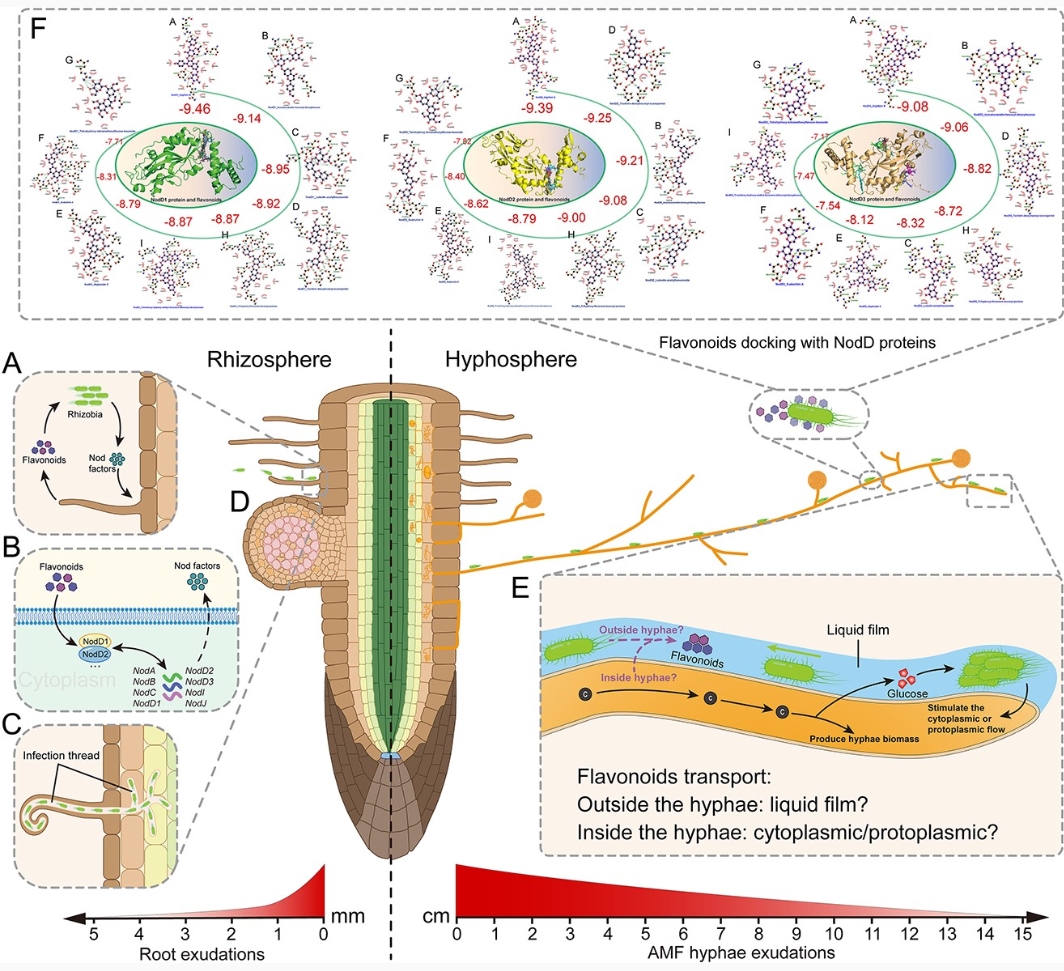
图7 AM真菌侵染的豆科植物吸收根瘤菌的两条途径的示意图。
在直接途径中(左侧),根分泌物通过释放类黄酮(A)介导根瘤菌的短距离补充(几毫米),对类黄酮的感知激活根瘤菌结瘤因子(B)的产生和分泌,随后刺激根毛围绕根瘤菌卷曲,通过侵染线穿透根毛(C),最终刺激根瘤的形成(D)。在间接途径中(右侧),与豆科植物相连的AM真菌的ERM释放糖(即葡萄糖),刺激根瘤菌的生长,并释放类黄酮,作为信号分子,使细菌能够感应到土壤中远距离(> 10 cm)相容宿主的存在(E)。反过来,根瘤菌刺激细胞质/原生质流动,增加分泌物的释放(即养分和信号)。从根部到菌丝顶端建立了分泌物/信号的梯度,这归因于(I)从菌丝基部到顶端的分泌物的稀释效应,(ii)菌丝数量和密度的减少,(iii)根毛和潜在的根际菌丝分泌物释放的组合。这种梯度起到化学引诱剂的作用,允许细菌向宿主植物的方向移动。在这个阶段,还不知道菌丝对类黄酮的运输是通过菌丝表面的液膜还是通过菌丝内的细胞质/原生质流。黄花倒水莲和10种黄酮类化合物(F)的NodD1(左)、NodD2(中)和NodD3(右)蛋白的电子结合研究。在这里,NodD类黄酮复合物是根据它们的结合亲和力排列的(负值越大,(kcal mol-1),相互作用越强)。在NodD-类黄酮相互作用期间,每个NodD-类黄酮复合物形成氢键(氨基酸和类黄酮之间的虚线)和疏水键(半圆)。中间的图片(椭圆形圆圈内)预测了苜蓿根瘤菌NodD蛋白中9种黄酮类化合物的结合位点。
摘要
(1) In soil ecosystems, rhizobia occupy the rhizosphere of legume roots to form nodules, a process triggered by microbial recognition of specific root-derived signals (i.e. flavonoids). 在土壤生态系统中,根瘤菌占据豆科植物根系的根际形成根瘤,这一过程是由微生物识别特定的根源信号(即黄酮类化合物)触发的。
(2) However, soil conditions can limit bacterial motility, restricting signal perception to the area directly influenced by roots. Legumes, like most plants of agricultural interest, associate with arbuscular mycorrhizal fungi, whose hyphae develop extensively in the soil, potentially providing an effective dispersal network for rhizobia. 然而,土壤条件会限制细菌的运动,将信号感知限制在受根直接影响的区域。像大多数农业植物一样,豆科植物与丛枝菌根真菌结合,其菌丝在土壤中广泛发育,潜在地为根瘤菌提供了有效的扩散网络。
(3) We hypothesized that mycelial networks of arbuscular mycorrhizal fungi play a role in signal transmission and act as a highway, enabling rhizobia to migrate from distant soil to the roots of leguminous plants. 我们假设丛枝菌根真菌的菌丝网络在信号传递中发挥作用,并充当高速公路,使根瘤菌能够从远处的土壤迁移到豆科植物的根部。
(4) Using in vitro and greenhouse microcosm systems, we demonstrated that Rhizophagus irregularis helps Shinorhizobium meliloti to migrate towards the legume Medicago truncatula, triggering nodulation, a mechanism absent without the arbuscular mycorrhizal fungus. 使用体外和温室微宇宙系统,我们证明了不规则根霉菌有助于苜蓿根瘤菌向豆科植物截形苜蓿迁移,触发结瘤,这是一种没有丛枝菌根真菌时不存在的机制。
(5) Metabolomics analysis revealed eight flavonoids unique to the compartment containing extraradical hyphae of the arbuscular mycorrhizal fungus linked to M. truncatula roots, associated with Sinorhizobium meliloti growth and nod gene expression. 代谢组学分析揭示了八种黄酮类化合物,其对于含有与截形苜蓿根相连的丛枝菌根真菌的根外菌丝的隔室是独特的,与苜蓿中华根瘤菌的生长和nod基因表达相关。
(6) Rhizobia plated on the extraradical hyphae connecting two plants (the legume M. truncatula and non-legume Solanum tuberosum) by a common mycelium network, showed preference for the legume, suggesting the chemoattraction by specific signals transported by the fungus connected to the legume. 接种在通过共同菌丝体网络连接两种植物(豆科植物截形苜蓿和非豆科植物马铃薯)的根外菌丝上的根瘤菌显示出对豆科植物的偏好,表明了与豆科植物连接的真菌所传递的特定信号的化学吸引。
(7) Simultaneously同时, S. meliloti stimulated the cytoplasmic/protoplasmic flow in the hyphae, likely increasing the release of nutrients and signals. Our results highlight the importance of extraradical hyphae根外菌丝 (i.e. the mycorrhizal pathway) of arbuscular mycorrhizal fungi for the migration of rhizobia over long distances to the roots, leading to nodulation同时,S. meliloti刺激了菌丝中的细胞质/原生质流,可能增加了营养物质和信号的释放。我们的结果强调了丛枝菌根真菌的根外菌丝(即菌根途径)对于根瘤菌长距离迁移到根部导致结瘤的重要性。
Words:
triggered by microbial recognition
Simultaneously 同时
extraradical hyphae 根外菌丝